U.S. Navy Blockades Strait of Hormuz: What Happens Now and the Stakes
COMMENT
SHARE

ADVERTISEMENT
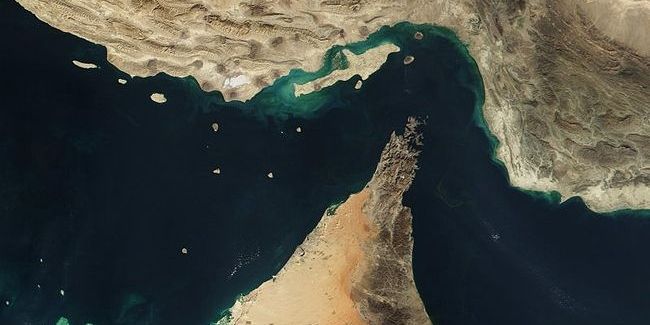
President Donald Trump announced Sunday that the U.S. Navy would begin blockading the Strait of Hormuz after weekend peace talks in Islamabad collapsed. The blockade took effect Monday at 10 a.m. ET. The stated goal is to pressure Iran to reopen the key oil route - "both of those things, certainly, and more," Trump told reporters outside the Oval Office.
What the Blockade Covers
The scope of the blockade has been a moving target.
Trump's initial Truth Social post described a broad stop on "any and all ships trying to enter, or leave, the Strait of Hormuz."
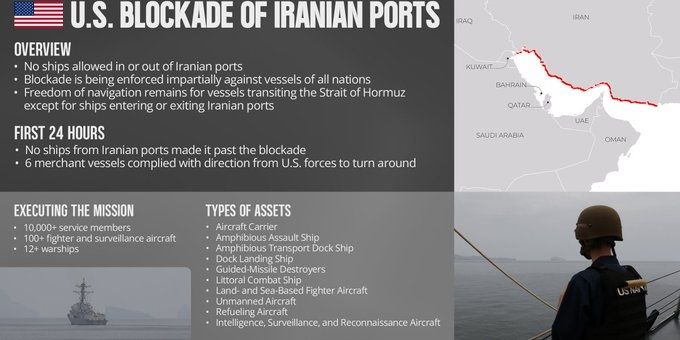
CENTCOM later clarified that the blockade "will not impede freedom of navigation for vessels transiting the Strait of Hormuz to and from non-Iranian ports," and that enforcement applies to ships entering or departing Iranian ports and coastal areas, including all Iranian ports on the Arabian Gulf and Gulf of Oman.
Trump additionally ordered the Navy to "seek and interdict every vessel in International Waters that has paid a toll to Iran," and announced that the U.S. would begin clearing mines Iran has laid in the strait.

Nobody Prepared You for Military Life
But we can help. Join over 100k spouses already getting the advice, resources, and military tea they need to thrive.
Ships Known to Be Involved
CENTCOM confirmed Sunday that two guided-missile destroyers - the USS Frank E. Peterson and the USS Michael Murphy - crossed through the Strait of Hormuz as part of mine-clearing operations.
Retired Admiral James Stavridis told CNN that an effective blockade would require two carrier strike groups and roughly a dozen surface ships outside the gulf, plus at least six destroyers operating inside it, along with support from partner navies such as the UAE and Saudi Arabia.
What It Looks Like in Practice
By early Monday, hours before the blockade took effect, real-time vessel tracking showed significantly fewer ships in the area compared to the prior day, with many appearing to steer clear proactively.
Two oil tankers - the Rich Starry, flagged to landlocked Malawi, and the Ostria, flagged to Botswana - turned away from the strait shortly after the blockade began, according to MarineTraffic data. At least one tanker appeared to defy the order and passed through.
Analysts describe the operation as less a classic historical blockade and more a "messy, high-risk interdiction regime" requiring the Navy to identify, track, hail, divert, and potentially board vessels - all in one of the most crowded and politically sensitive waterways in the world.
What Leaders Are Saying
ADVERTISEMENT
United States
Trump framed the blockade as a response to Iranian extortion, saying the situation was "ALL OR NONE" - no ships pass until Iran relents - and that the U.S. would not allow Iran to profit from a waterway it has no right to police. He later warned that any Iranian ships approaching the blockade "will be immediately ELIMINATED."
Iran
Iran's unified military command declared that the U.S. action is "an illegal act and amounts to piracy," and stated that if the security of its ports is threatened, no port in the region "will be safe."
Islamic Revolutionary Guard Corps (IRGC) officials stated that any military vessel approaching the strait would be considered a ceasefire violation and would meet a "severe response."
European Union
European Commission President Ursula von der Leyen called freedom of navigation in the strait "of paramount importance" while drawing attention to the broader economic damage of the war. EU foreign policy chief Kaja Kallas said there was "no appetite" among member states for extending any existing naval mission to Hormuz, stating bluntly: "Nobody wants to go actively in this war."
ADVERTISEMENT
United Kingdom and France
British Prime Minister Keir Starmer announced plans to convene a summit of leaders to push for reopening the strait, saying it must reopen with "no conditions and no tolls."
French President Emmanuel Macron announced preparations for a "peaceful multinational mission aimed at restoring freedom of navigation," with a conference planned in the coming days alongside the UK. Despite Trump's claim that the UK would participate in the blockade, a UK government spokesperson clarified that London would not join a blockade, instead working toward a "wide coalition to protect freedom of navigation."
Gulf States
ADNOC CEO Sultan Al Jaber stated bluntly that "the Strait of Hormuz is not open" despite the ceasefire, calling Iranian restrictions "coercion" and warning that "every day the Strait remains restricted, the consequences compound" for energy markets, households, and economies worldwide.
In a separate post, he declared the strait has never been Iran's to close and called the situation a direct threat to global energy, food, and health security.
Israel
Israel killed Iran's top naval commander, Alireza Tangsiri, in late March, with Defense Minister Israel Katz accusing him of being "directly responsible" for the Hormuz blockade. Israel's military focus has since shifted toward Lebanon during the ceasefire period, with IDF officials describing it as the "main operational front."
ADVERTISEMENT
The Economic Stakes
Iran's closure of the strait has blocked roughly 12 million barrels of oil from world markets daily since the war began. JPMorgan has warned that Western countries could reach operational reserve minimums by early May. Oil prices topped $100 a barrel again Monday following the blockade announcement, with some analysts projecting $110 if the standoff continues.
The U.S. and Iran remain in indirect communication, and Trump has said Tehran wants to make a deal "very badly." Whether the blockade accelerates diplomacy or hardens Iranian resolve remains the central question.
Continue Reading

Could New Legislation Help Military Families Cover Diaper Costs?
Childcare

How to Build a PCS Binder: A Step-by-Step Guide for Military Spouses
PCS Advice

Pilot Program Reimburses Cost of Flying Family in to Watch Kids During a PCS
Childcare
Join the Conversation

BY MICKEY ADDISON
Military Affairs Analyst at MilSpouses
Mickey Addison is a retired U.S. Air Force colonel and former defense consultant with over 30 years of experience leading operational, engineering, and joint organizations. After military service, he advised senior Department of Defense l...
- PMP
- MSCE
ADVERTISEMENT


ADVERTISEMENT
